

.png "Scott Friedman")
Denial rates are climbing. Prior authorization is consuming staff time organizations can't afford to lose. And most BH systems weren't built to handle any of it. Here's the reality — and what the practices holding their ground are doing differently.
I talk to behavioral health and substance use disorder organizations every week — outpatient clinics, residential programs, IOP and PHP providers, community mental health centers, dual diagnosis facilities. And in 2026, the story I keep hearing is the same one with a different letterhead: they're working harder than ever, and their revenue isn't keeping up.
That's not an impression. It's what the data confirms.
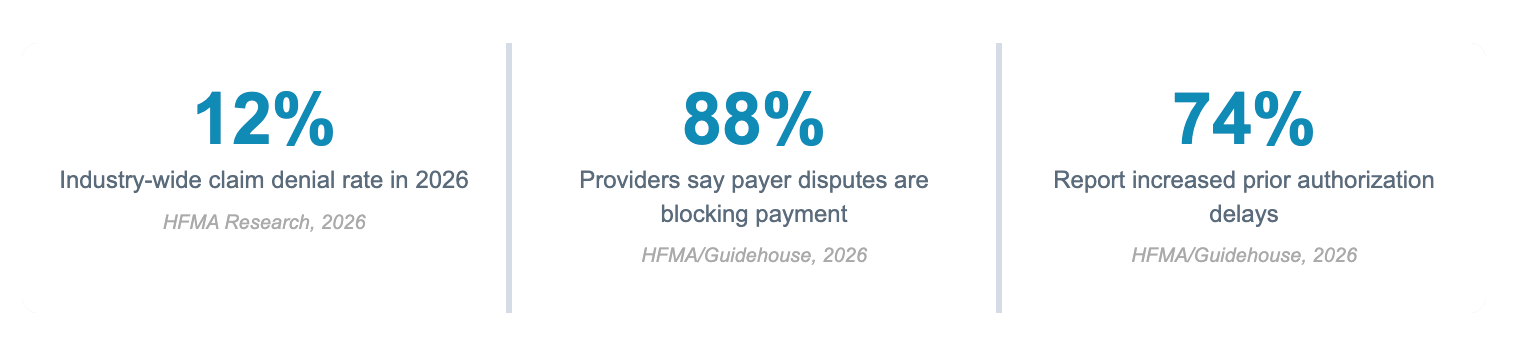
In behavioral health, those numbers hit harder than in most other specialties. BH claims are disproportionately targeted for medical necessity reviews, level-of-care disputes, and authorization-related denials. Payers are deploying AI to reject claims faster than manual billing teams can respond. And documentation requirements keep climbing even as clinical staff bandwidth shrinks.
Three Things I Hear from BH Organizations Every Week
"Prior auth is consuming us."
AMA survey data confirms what every BH administrator already feels: physicians and staff complete an average of 39 prior authorization requests per physician per week — at least 13 hours of staff time. In substance use treatment, where levels of care shift and authorizations are required at every transition, that number runs even higher. I've spoken with organizations that had three different staff members touching every single prior auth request. That's not a workflow — that's an unsustainable drain on people and money.
New CMS rules that took effect January 2026 now require payers to decide standard prior auth requests within 7 calendar days and expedited requests within 72 hours. That's progress. But to take advantage of it, your organization needs the internal workflows and technology to keep pace. Most organizations I talk to don't have that yet.
"We don't know where our money is."
Most practices can tell me their monthly collections number. Very few can tell me their denial rate by payer, their first-pass resolution rate, or exactly how much AR is sitting past 90 days. Without that visibility, you're managing symptoms rather than causes — and you're writing off revenue that could be recovered if you knew where to look.
The MGMA benchmark for days in AR is under 40. For behavioral health, 55 to 75 days is common. Every day above that benchmark is cash you've already earned that you haven't collected.
"Our EHR doesn't support our billing."
Behavioral health billing is not general medical billing. Therapy session documentation, ASAM criteria, group notes, level-of-care justification, MAT records — these have to connect directly to what gets coded and submitted. When the clinical and billing workflows are disconnected, denials follow predictably and repeatedly. The organizations that outperform have one thing in common: clinical documentation flows directly into coding, and coding flows into clean claims.
What's Actually Working in 2026
The practices holding their ground — and in some cases improving performance — are investing in specific capabilities that move denial rates and AR days in the right direction. Here's what's working:
- AI ambient documentation. Tools like MedicsScribeAI capture therapy and psychiatry sessions during the encounter and generate complete, compliant clinical notes automatically — including 30-, 60-, and 90-minute session formats. Better notes mean better documentation, which means fewer denials tied to medical necessity gaps. Clinicians also get time back they were spending documenting after hours.
- Real-time eligibility verification at every visit. Not just at intake — at every single visit. Approximately 22% of preventable denials trace directly back to eligibility errors. Running verification once and assuming it holds is a revenue risk. The organizations catching this are doing it automatically before every encounter.
- Denial prediction before claims go out. AI-powered claim scrubbing that flags at-risk claims before submission — based on payer-specific patterns, documentation gaps, and prior authorization status. This is the shift from reactive denial management to proactive revenue protection. Organizations making this shift are recovering margin they didn't know they were losing.
- Prior authorization automation. Tools that auto-fill auth forms, monitor payer requirements in real time, and alert staff to missing documentation before submission. Early adopters are seeing prior auth turnaround time cut by up to 80% in some documented deployments — and the time their staff gets back is significant.
- Patient financial engagement tools. Pre-admission cost estimates, digital payment options, text-to-pay, and flexible payment plans. Patient collection rates industry-wide sit between 34–48%. The practices improving that number are the ones making it easier for patients to understand and pay their balance — not the ones sending paper statements and hoping.
How ADS Addresses These Challenges Specifically
Advanced Data Systems has supported behavioral health and substance use disorder providers since 1977. The MedicsCloud Suite wasn't adapted from a general medical platform — it was built with BH workflows in mind from the ground up.
For outpatient practices: structured templates for individual therapy, psychiatry, group sessions, and progress notes. Built-in ASAM assessment integration that uses AI to generate actionable treatment plan problem lists directly from completed evaluations. MedicsScribeAI for documentation capture during the session. A patient portal for scheduling, digital intake, and payment.
For inpatient and residential programs: bed management, compliance tracking for in-person visit requirements, level-of-care documentation, and revenue cycle tools built for UB claims — not just HCFA. The same platform supports detox, residential, IOP, PHP, partial hospitalization, and MAT across a single system.
For organizations that want to hand off billing entirely: MedicsRCM from ADSRCM is a full-service outsourced revenue cycle management option with a team of approximately 300 experienced billers, a near-100% first-pass claim acceptance rate across commercial and Medicaid/Medicare payers, and the same MedicsCloud Suite technology underneath. Organizations typically see a 10–20% revenue increase after transitioning.
Clients including Catholic Charities, New Bridge Medical Center, New Hope Foundation, Valley Vista, 1016 Recovery Network, and Hispanic Counseling Center trust ADS with their behavioral health operations.
The Bottom Line
Behavioral health organizations are doing some of the most important work in healthcare — often for populations that have nowhere else to go. The revenue cycle should support that work, not undermine it.
If your denial rate is climbing, your AR is aging, your staff is overwhelmed by prior auth, or your clinical documentation and billing systems aren't talking to each other — those aren't isolated billing problems. They're operational problems with billing symptoms. And they're solvable with the right technology and the right partner.
I'm happy to talk through what you're seeing at your organization. Drop a comment, reach out directly, or book a conversation with our team below.
Frequently Asked Questions: Behavioral Health Billing in 2026
Why is behavioral health billing harder than other medical specialties?
Behavioral health billing involves documentation requirements unique to the specialty — ASAM criteria, level-of-care justification, group therapy notes, and medical necessity standards that vary by payer — plus prior authorization at every transition of care. General billing systems adapted for BH miss these requirements, which leads to higher denial rates, compliance gaps, and revenue loss. A platform built specifically for behavioral health handles these workflows natively.
What is the average denial rate for behavioral health organizations in 2026?
Industry-wide denial rates reached approximately 12% in 2026 according to HFMA research, with behavioral health organizations often running higher due to medical necessity disputes and prior authorization issues. MGMA benchmarks target below 8%, with best-in-class organizations achieving below 5%. The difference between 12% and 5% in annual revenue is substantial for any BH organization.
How does AI help behavioral health billing and revenue cycle management?
AI supports BH revenue cycle management in several concrete ways: ambient documentation tools like MedicsScribeAI capture therapy and psychiatry sessions and generate compliant clinical notes automatically; AI-powered claim scrubbing flags documentation gaps before claims are submitted; denial prediction identifies at-risk claims before they leave the practice; and prior authorization automation reduces the manual workload that consumes 13+ hours of staff time per physician per week. Organizations deploying AI across their revenue cycle are reporting a 27% reduction in cost-to-collect and a 6% increase in net patient revenue.
What should behavioral health organizations look for in an EHR and billing system?
Look for systems built specifically for BH workflows — not general platforms adapted for behavioral health. Key capabilities include structured templates for therapy, psychiatry, group sessions, and progress notes; ASAM assessment integration; prior authorization tracking; real-time eligibility verification; AI-assisted documentation capture; and an integrated or outsourced revenue cycle management component with denial prediction and AR monitoring. Advanced Data Systems' MedicsCloud Suite covers all of these in one integrated platform, with MedicsRCM available for organizations that prefer to outsource billing entirely.
What is the prior authorization rule change that affects behavioral health in 2026?
The CMS Interoperability and Prior Authorization Final Rule (CMS-0057-F), effective January 2026, now requires Medicare Advantage, Medicaid, and CHIP managed care plans to decide standard prior authorization requests within 7 calendar days and expedited requests within 72 hours, and to provide a specific reason for every denial. FHIR-based electronic prior authorization requirements follow January 1, 2027. BH organizations still managing prior auth manually will face increasing difficulty keeping pace with these timelines.